
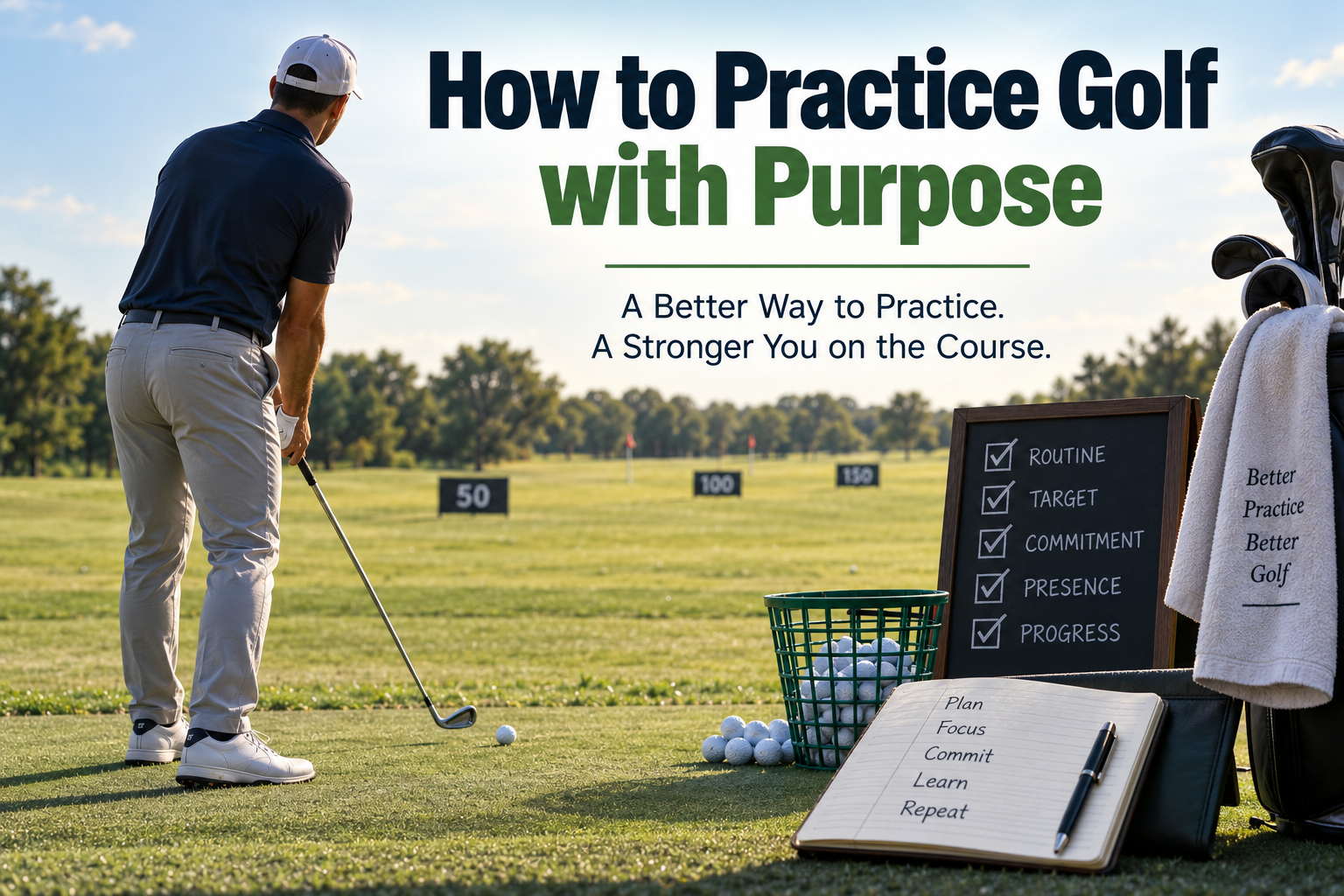
How to Practice Golf with Purpose: The Mental Architecture of Improvement
“`html
Most golfers want to get better, but simply spending more time practicing doesn’t guarantee improvement.
You can hit hundreds of balls on the range, feel as though you’ve found something, and then step onto the golf course the next day and wonder where it went.
That’s because playing golf asks you to do something very different from hitting balls on a range.
On the range, you might hit ten seven-irons in a row from the same lie to the same target.
On the course, you get one attempt.
The target changes.
The club changes.
The lie changes.
There are consequences.
And you have to make a decision before every shot.
If you want to learn how to practice golf with purpose, the answer isn’t simply to make every practice session harder or put yourself under pressure all the time.
It’s to understand what you’re trying to improve and then structure your practice accordingly.
Sometimes that means technical repetition.
Sometimes it means practicing your routine.
Sometimes it means creating pressure.
And sometimes it means putting one ball down, choosing a target and practicing exactly what you’re going to have to do on the golf course:
Make a decision. Commit. Hit the shot. Accept the result. Start again.
Key Takeaways
- Every practice session should have a clear purpose.
- Technical practice and performance practice serve different purposes, and golfers need both.
- Don’t judge every practice session solely by how well you hit the ball.
- Performance practice should include changing clubs, changing targets and using one ball.
- Your pre-shot routine should be practiced just like any other golf skill.
- Adding consequence can help you learn how your thinking and behavior change under pressure.
- A Mental Scorecard can help you measure commitment, focus and routine rather than just outcomes.
- Quality practice doesn’t have to take hours. Twenty focused minutes can be extremely valuable.
What Is Purposeful Golf Practice?
Purposeful golf practice begins with a simple question:
“What am I trying to improve today?”
Without an answer, it’s very easy to arrive at the range, buy a bucket of balls and start hitting.
You hit a few wedges.
Then some irons.
Then driver.
If you’re hitting it well, you leave feeling confident.
If you’re hitting it badly, you stay longer trying to fix it.
But what did you actually practice?
Give Every Session an Objective
Your objective might be technical:
“I’m working on the movement my coach gave me.”
It might be performance-based:
“I’m going to practice committing to a different target with every shot.”
Or mental:
“Today I’m going to practice my response after poor shots.”
All three can be valuable.
The important thing is knowing why you’re doing what you’re doing.
Don’t Confuse Hitting Balls With Practicing
There is nothing wrong with occasionally hitting balls simply because you enjoy it.
Golf is supposed to be enjoyable.
But if your objective is improvement, more isn’t automatically better.
Twenty highly engaged shots can sometimes teach you more than 100 balls hit without much thought or intention.
Want to make your mental game part of your practice? Download my free ebook, 7 Key Mental Strategies, and learn practical strategies to improve your focus, confidence and performance on the course. Get the Free Ebook
Technical Practice vs. Performance Practice
One of the biggest mistakes golfers make is assuming that all practice should look the same.
It shouldn’t.
Technical practice and performance practice have different objectives.
Technical Practice
If you’re making a swing change, repetition can be extremely useful.
You may need to:
- Hit the same club repeatedly.
- Use a training aid.
- Make exaggerated rehearsals.
- Check video.
- Hit balls at reduced speed.
- Focus internally on a particular movement or feel.
That’s not bad practice.
You’re trying to learn or refine a movement.
Performance Practice
But playing golf requires different skills.
You need to:
- Assess a situation.
- Choose a target.
- Select a club.
- Commit to a shot.
- Execute it once.
- Accept the result.
- Start the process again with a completely different shot.
That’s what performance practice should prepare you for.
Know Which Mode You’re In
Before practicing, ask:
“Am I training a movement or training myself to perform?”
If you’re training a movement, technical thinking may be completely appropriate.
If you’re practicing performance, start making the environment more like playing golf.
How to Practice Golf With Purpose
A purposeful practice session doesn’t need to be complicated.
I like to think about four questions.
1. What Am I Working On?
Choose something specific.
Not:
“I want to hit it better.”
But:
“I’m going to practice committing fully to every target.”
Or:
“I’m going to work on the technical movement my coach gave me.”
2. How Will I Practice It?
Choose a practice environment that matches the skill.
If you’re learning technique, repetition may help.
If you’re working on decision-making, change targets.
If you’re working on pressure, create consequence.
If you’re working on routine, use your routine before every ball.
3. How Will I Measure It?
Decide what success looks like.
If you’re practicing commitment, don’t grade yourself purely on ball flight.
Ask:
“How committed was I?”
If you’re practicing routine:
“Did I complete my process?”
Measure the skill you’re actually trying to improve.
4. What Did I Learn?
Before leaving, take a minute to review the session.
What improved?
What was difficult?
What happened when you felt pressure?
What do you want to work on next time?
Now practice becomes a learning process rather than simply a collection of golf shots.
Practice Your Pre-Shot Routine
Golfers often tell me they want a more consistent pre-shot routine.
Then I ask how often they practice it.
The answer is frequently:
“I don’t.”
If you want your routine to appear naturally during competition, practice it before competition.
Don’t Save Your Routine for the Golf Course
During performance practice, go through the same basic process you’d use during a round.
Gather the information.
Choose the shot.
Select a target.
See what you want to do.
Commit.
Hit the ball.
Then respond to the result.
Practice the Transition From Thinking to Playing
One of the most important functions of your routine is helping you move from analysis into execution.
Before the shot, you need to think.
But once the decision has been made, the objective changes.
You want to become increasingly connected to:
- The target.
- The intended shot.
- Feel.
- Commitment.
That’s a skill.
And skills improve through practice.
Use One-Ball Practice
One of the easiest ways to make your practice more representative of golf is to stop immediately correcting every shot with another ball.
On the course, you don’t get another attempt.
Change the Problem After Every Shot
Hit a driver to one target.
Then hit an eight-iron somewhere else.
Then a wedge.
Then perhaps another driver.
Go through your process every time.
Now your brain has to continually:
- Reassess.
- Make decisions.
- Change targets.
- Change clubs.
- Reset.
That’s much closer to playing golf.
You Don’t Have to Do This for the Entire Session
If you’re working technically, you may spend the first part of your session using repetition.
Then switch modes.
For example:
20 minutes technical practice → 20 minutes performance practice.
Now you’re giving yourself an opportunity to take what you’ve been working on and use it in a more golf-like environment.
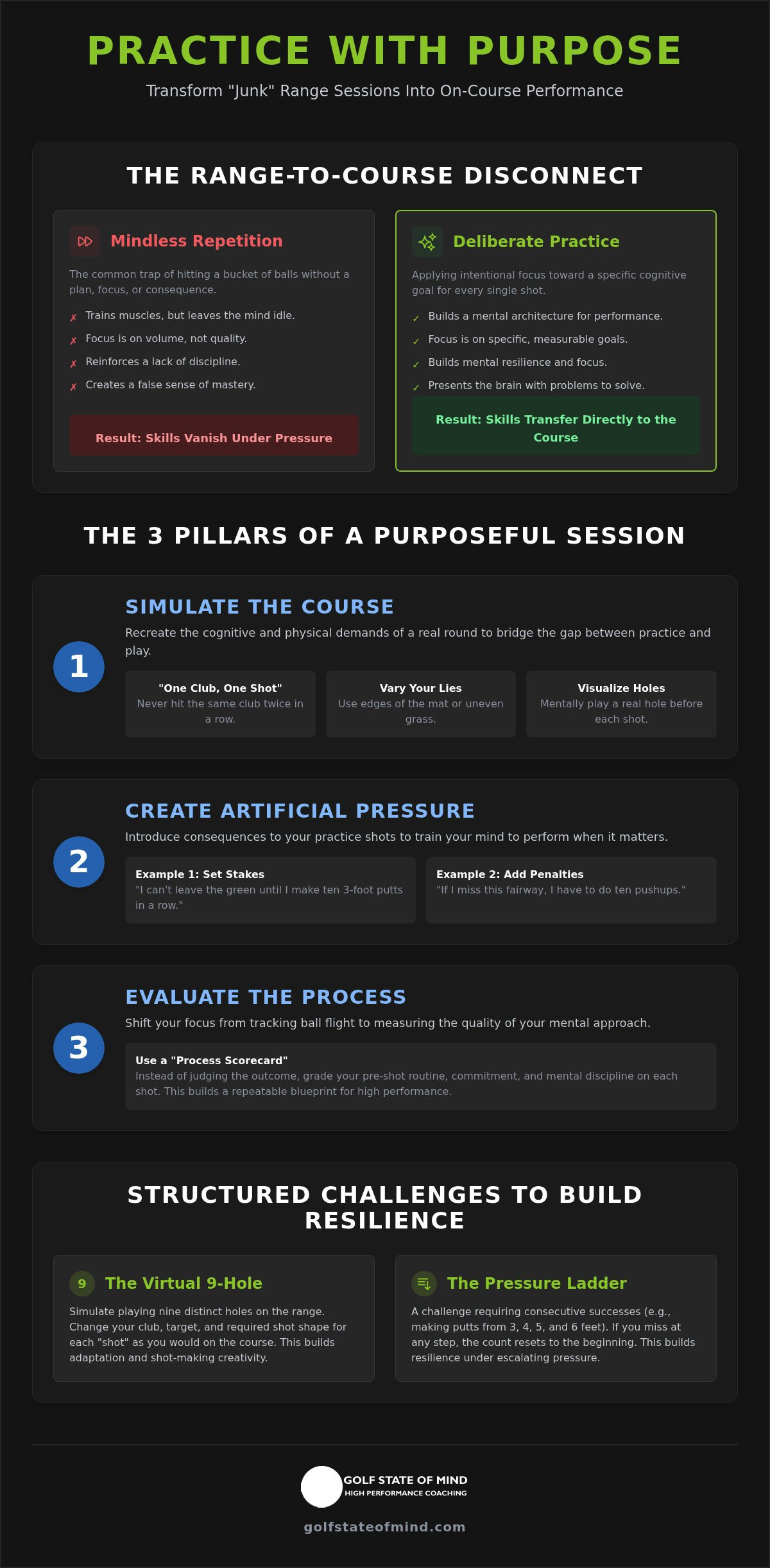
Play the Course on the Range
This is one of my favorite ways to practice golf with purpose.
Choose a golf course you know well.
Then play it on the range.
Start on the First Tee
Imagine the first hole.
What’s the shape?
Where is the trouble?
What is your target?
Choose the appropriate club and hit the tee shot using your full routine.
Let the Result Determine the Next Shot
If you hit a good drive, imagine where it finished and choose an appropriate approach club.
If you hit it poorly, don’t simply reload another driver.
Play from the imaginary position you’ve created.
Perhaps now you need a low recovery shot.
That’s golf.
Continue Through the Course
You’re now practicing:
- Course strategy.
- Decision-making.
- Club changes.
- Target changes.
- Routine.
- Commitment.
- Response to mistakes.
You’re not simply practicing golf swings.
You’re practicing playing golf.
Add Pressure and Consequence
One of the biggest differences between practice and playing is consequence.
On the range, a poor shot costs nothing.
You pull another ball across and try again.
On the course, you have to live with the result.
That’s why some practice should include consequence.
Pressure Doesn’t Need to Be Extreme
You don’t need to turn every practice session into a stressful experience.
Simply create a goal that matters enough to change how you feel.
For example:
- Hit 4 out of 5 imaginary fairways.
- Get 5 out of 7 chips inside a defined circle.
- Hole 10 consecutive three-foot putts.
- Hit 3 consecutive shots into a target area.
- Finish a putting game below a particular score.
Once you’re close to completing the challenge, notice what happens.
Do you become careful?
Does your routine change?
Do you start thinking about the outcome?
Does your body feel different?
That’s useful information.
Practice Responding to Pressure
Don’t judge yourself for becoming nervous.
That’s exactly why you’re doing the exercise.
Return to your process.
See the target.
Commit.
Execute.
You’re practicing performing while something matters.
Use a Mental Scorecard
If you judge every practice session entirely by ball flight, your confidence will continually rise and fall with your most recent shots.
A Mental Scorecard gives you another way to measure your practice.
Choose One or Two Behaviors
You might track:
- Commitment.
- Routine.
- Target focus.
- Acceptance.
- Response to mistakes.
- Staying present.
Keep it simple.
Separate Process From Outcome
Imagine you choose a clear target, see the shot, feel committed and make a free swing.
The ball finishes slightly right of your target.
Was that a failed mental rep?
Not necessarily.
You may have executed the mental skill extremely well.
Now imagine you stand over another shot full of doubt, make a tentative swing and the ball takes a lucky bounce onto the green.
Good outcome.
Poor mental execution.
Learning to distinguish between those two things is one of the most valuable parts of purposeful practice.
Practice Your Response to Mistakes
You don’t only need to practice good golf.
You need to practice what you do when golf becomes difficult.
Notice Your Reaction
After a poor practice shot, observe what happens.
Do you immediately grab another ball?
Do you become technical?
Do you criticize yourself?
Do you rush?
These are the same patterns that can appear on the golf course.
Practice the Response You Want on the Course
Instead of immediately hitting another ball:
- Allow yourself to react.
- Take any useful information from the shot.
- Accept the result.
- Reset.
- Begin your process again.
You don’t need an arbitrary number of seconds or steps.
The objective is simply to become better at leaving the previous shot where it belongs.
How to Practice With Purpose in 20 Minutes
You don’t need two hours to have a valuable practice session.
If you only have 20 minutes, you can still create a highly focused performance session.
Minutes 1–5: Warm Up
Hit some short shots.
Move gradually through a few clubs.
Don’t judge your game.
You’re preparing your body.
Minutes 6–10: One Specific Skill
Choose one thing to work on.
That might be:
- A technical feel.
- Distance control.
- Shot shape.
- Commitment.
- Target focus.
Minutes 11–17: Performance Practice
Change club and target after every shot.
Use your full routine.
Alternatively, play several imaginary holes.
Minutes 18–20: Finish With Consequence
Create one challenge.
Give yourself a clear target.
See what happens when completing the challenge begins to matter.
Then finish.
That’s 20 minutes of purposeful practice rather than 20 minutes of simply hitting balls.
Want to develop the mental skills you can practice alongside your physical game? Download my free 7 Key Mental Strategies ebook for practical strategies to improve confidence, focus and performance. Download the Free Ebook
Make Your Practice Transfer to the Course
The goal of practice isn’t to become great at practicing.
It’s to become better at playing golf.
That means understanding what you’re trying to improve and choosing the right type of practice for that objective.
Sometimes you need repetition.
Sometimes you need feedback.
Sometimes you need variety.
Sometimes you need pressure.
And sometimes you simply need one ball, one target and one opportunity.
If you want to know how to practice golf with purpose, start by making every session answer three questions:
What am I working on?
How am I going to practice it?
How will I know whether I did it well?
Then practice the mental behaviors you want to take onto the golf course.
Because when the first tee arrives, you don’t get another ball.
You get one shot.
Practice for that.
Frequently Asked Questions
How do I practice golf with purpose?
Start every practice session with a specific objective. Decide what you’re trying to improve, choose a practice method that matches that objective and determine how you’ll measure success. Technical improvement may require repetition, while performance skills are better practiced through changing clubs and targets, using your routine and introducing consequence.
What is purposeful practice in golf?
Purposeful golf practice means practicing with a clearly defined intention rather than simply hitting balls. The purpose might be technical improvement, distance control, decision-making, routine, commitment, pressure management or another specific skill.
Is hitting lots of golf balls bad practice?
Not necessarily. Repetition can be extremely useful when learning or refining a technical movement. The problem is hitting balls without knowing what you’re trying to accomplish. Match the type of practice to the skill you’re developing.
What’s the difference between block practice and performance practice?
Block practice generally involves repeating a similar movement or shot and can be useful for technical learning. Performance practice introduces more of the demands of the golf course, including changing clubs, targets and situations, making decisions and getting one attempt at each shot.
How can I make driving-range practice more like playing golf?
Change clubs and targets frequently, use your full pre-shot routine and give yourself only one attempt at each shot. You can also visualize a course you know and play imaginary holes based on where each range shot would have finished.
How can I practice golf under pressure?
Create challenges with a clear consequence. You might need to hit a certain number of targets, hole consecutive putts or complete a scoring game. The purpose is to notice how your thinking, routine and commitment change when the outcome begins to matter and then practice returning to your process.
Should I use my pre-shot routine on the driving range?
Yes, particularly during performance practice. If you want your routine to become reliable on the course, you need to rehearse it in practice. You don’t necessarily need to use your full routine during every technical repetition, but it should be an important part of performance-based practice.
How do I know if a golf practice session was successful?
Judge the session according to its objective. If you were working technically, evaluate the movement or feedback you were given. If you were practicing commitment, routine or focus, measure those behaviors rather than judging the session entirely by ball flight.
Can I practice golf effectively in only 20 minutes?
Yes. A short session can be extremely valuable if it has a clear purpose. Spend a few minutes warming up, work deliberately on one skill, then finish with performance practice or a consequence-based challenge.
Should golfers practice their weaknesses or strengths?
Both have value. Weaknesses may require specific attention because they’re costing you shots, while strengths should continue to be developed and tested under performance conditions. Your practice priorities should reflect your individual game rather than a fixed rule about how much time must be spent on each.
How do I stop mindlessly hitting balls at the range?
Before every section of your practice, decide what you’re trying to accomplish. Use specific targets, change clubs during performance practice, score drills and stop periodically to evaluate what you’re learning. If your concentration has gone completely, taking a break can be more productive than continuing simply because there are balls left in the bucket.
“`
Get your FREE Mental Game Scorecard

How To Practice More Effectively