

Golf Performance Coaching: The Mental Blueprint for Peak Performance in 2026
You know you can hit the shots.
You’ve seen them on the practice range. You’ve hit them during casual rounds. You’ve probably played stretches of golf where everything felt relatively simple.
But when the result matters, something changes.
You start thinking more.
You become more aware of your swing.
You worry about where the ball might go.
A mistake becomes harder to let go of.
And suddenly it becomes more difficult to access the skills you already possess.
This is where golf mental performance coaching can help.
The purpose isn’t to give you a new golf swing.
It’s to help you develop the mental skills, processes and habits that allow you to express your existing physical skills more consistently — particularly when there’s pressure, uncertainty and consequence.
That includes how you prepare, what you focus on, how you make decisions, how you respond to mistakes, how you manage pressure and how you practice.
Ultimately, good golf performance coaching should make the game feel simpler, not give you more things to think about.
Key Takeaways
- Golf mental performance coaching helps you access your existing physical skills more consistently when the result matters.
- Mental coaching complements good technical coaching rather than replacing it.
- A strong mental game is not about eliminating nerves, negative thoughts or frustration.
- Player identity and process give you clear guidelines for how you want to compete.
- Pre-shot and post-shot routines help separate decision-making, execution and recovery.
- Confidence is built through preparation, evidence and committed action rather than forced positive thinking.
- Performance practice helps bridge the gap between the driving range and the golf course.
- A Mental Scorecard allows you to measure the quality of your mental execution independently of score.
- Effective coaching should be individualized to the golfer rather than based on a collection of generic mental-game tips.
What Is Golf Mental Performance Coaching?
Golf mental performance coaching focuses on the psychological skills and behaviors that influence how effectively you perform on the golf course.
That can include:
- Confidence.
- Focus and concentration.
- Decision-making.
- Pre-shot routines.
- Post-shot routines.
- Emotional control.
- Handling pressure.
- Responding to mistakes.
- Visualization.
- Self-talk.
- Practice habits.
- Player identity.
- Preparation and post-round review.
But the simplest way I explain it is this:
Your physical skills determine what you’re capable of doing. Your mental skills influence how consistently you’re able to access those abilities when you play.
The goal isn’t to manufacture a perfect mental state.
It’s to give you a better way of competing.
Why Does the Mental Game Matter?
Golf creates a very different environment from most practice sessions.
There’s uncertainty.
There’s consequence.
You have plenty of time to think.
And you get one attempt at every shot.
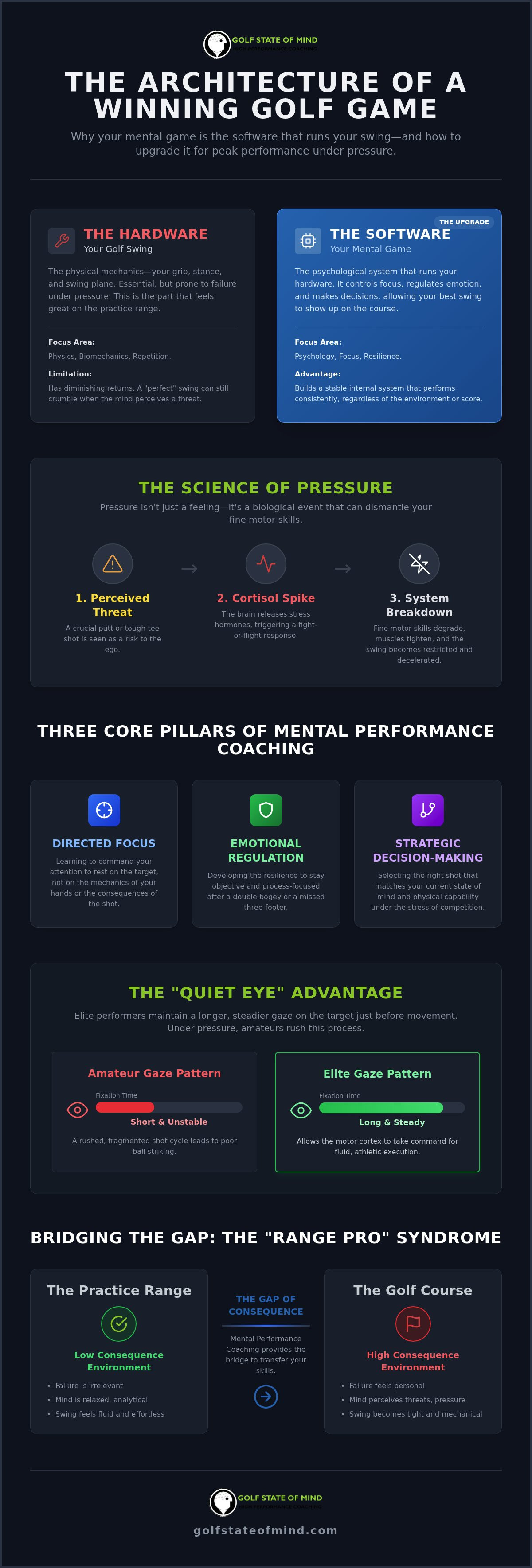
The Range and Golf Course Are Different
On the range, you can hit seven-irons repeatedly.
If you hit one poorly, there’s another ball waiting.
By the fifth or sixth attempt, you’ve adjusted to the club, target and movement.
On the course, you may not have hit a seven-iron for 30 minutes.
Now you have 158 yards, water short, wind from the left and one ball.
That shot counts.
It’s not surprising that it feels different.
Pressure Can Change the Way You Play
When golfers care more about the result, they often try harder to control it.
They become more technical.
They steer the ball.
They become indecisive.
They focus on hazards.
They start thinking about score.
They worry about what other people think.
Golf performance coaching helps you recognize those patterns and develop better responses to them.
Want to strengthen your mental game? Download my free ebook, 7 Key Mental Strategies, for practical ways to improve your confidence, focus, commitment and ability to perform under pressure. Get the Free Ebook
Mental Performance Coaching vs. Swing Coaching
Golfers sometimes make the mistake of treating technical coaching and mental coaching as competing approaches.
They aren’t.
They solve different problems.
What Does a Swing Coach Do?
A good swing coach helps you improve areas such as:
- Movement.
- Club delivery.
- Ball striking.
- Shot patterns.
- Technique.
If your technical skills need improvement, mental coaching isn’t a substitute for that work.
What Does a Mental Performance Coach Do?
A mental coach might ask:
- Why can you access your swing freely in practice but struggle during competition?
- What happens to your attention when you’re nervous?
- Why does one mistake sometimes affect the next three holes?
- Why do you become indecisive when you’re playing well?
- Why do you start protecting your score?
- What changes when other people are watching?
- How effectively does your practice prepare you to perform?
Those are performance problems rather than simply swing problems.
Sometimes There Is a Technical Problem
It’s equally important not to blame everything on the mental game.
If you’re hitting the same poor shot on the range and course, there may be a technical issue that needs attention.
Good coaching should help you distinguish between the two rather than automatically assuming every poor performance is psychological.
What Does a Golf Performance Coach Help With?
Every golfer is different, but common areas I work on with players include:
- Playing better in tournaments.
- First tee nerves.
- Fear of failure.
- Overthinking.
- Loss of confidence.
- Difficulty recovering from mistakes.
- Getting too focused on score.
- Playing defensively when performing well.
- Fear of what other people think.
- Poor decision-making under pressure.
- Difficulty taking the range game to the course.
- Putting or short-game anxiety.
- Practice that doesn’t transfer into performance.
But underneath many of these problems is the same challenge:
Can you access the skills you already possess when it matters most?
1. Player Identity: Decide How You Want to Show Up
One of the first things I want a player to understand is who they want to be when they compete.
Not what they want to shoot.
Not where they want to finish.
How do they want to show up?
That might mean being:
- Committed.
- Patient.
- Brave.
- Resilient.
- Present.
- Accepting.
- Decisive.
These qualities become a reference point when the round gets difficult.
You Are More Than Your Golf
This is especially important with junior and competitive golfers.
You are a person first and a golfer second.
Golf is something you do. It isn’t who you are.
When performance becomes too closely connected to identity, every tournament can start to feel like a judgment of personal worth.
Separating the person from the performance creates greater freedom to compete.
2. Build a Process You Can Trust
Golfers naturally care about outcomes.
They want to shoot lower scores.
Win tournaments.
Make teams.
Earn scholarships.
Lower their handicap.
There’s nothing wrong with those goals.
But during a round, you need something more useful to direct your attention toward.
Create Process Goals
Your process might include:
- Choose clear targets.
- Make committed decisions.
- Use your routine.
- Accept each result.
- Respond constructively to mistakes.
- Return attention to the present.
These are behaviors you can influence.
Redefine Success
Your score matters.
But it isn’t the only measure of whether you competed well.
At the end of the round, ask:
“How well did I follow my process?”
“How well did I show up as the player I wanted to be?”
That’s how the mental game becomes trainable.
3. Improve Focus and Attention
Good focus doesn’t mean concentrating intensely for four hours.
It’s about knowing where your attention needs to be and being able to return it when it wanders.
Focus On
When it’s time to prepare for the shot:
Narrow your mind.
Assess the situation.
Choose the shot.
Choose the target.
Commit.
Execute.
Focus Off
Once the shot is finished, allow your attention to broaden.
Walk.
Talk.
Notice your surroundings.
Give your mind a break.
Focus Is About Returning
You will think about your score sometimes.
You will remember the previous shot.
You may wonder what someone else is shooting.
That’s normal.
The skill is recognizing that your attention has moved somewhere unhelpful and bringing it back when you need it.
4. Build More Reliable Confidence
Golfers often think confidence means:
“I know I’m going to play well.”
But you can never know that.
Golf contains too much uncertainty.
Build Confidence From Evidence
Useful evidence includes:
- Your preparation.
- Quality practice.
- Previous good performances.
- Improvement you’ve made.
- Times you’ve handled adversity well.
- Commitments you’ve kept to yourself.
Don’t Wait to Feel Confident
This is one of the most important principles I teach.
Commitment doesn’t have to wait for confidence.
You can feel uncertain and still make a committed swing.
Sometimes confidence is the result of seeing yourself take committed action while you don’t feel completely confident.
5. Learn to Perform Under Pressure
The goal of mental training isn’t to eliminate pressure.
If the outcome matters to you, you’re probably going to feel something.
That’s part of competition.
Accept the Nerves
Your heart might beat faster.
Your hands might feel different.
You may notice tension.
None of that automatically prevents you from performing well.
Regulate When Necessary
One breathing exercise I use with players is:
Inhale for 4 seconds. Exhale for 6 seconds.
Use several breaths before the round or between shots if your arousal feels too high.
The objective isn’t to force yourself into complete calm.
It’s to become regulated enough to perform.
Narrow the Mind
Pressure tends to pull attention into the future:
“What if I win?”
“What if I don’t qualify?”
“What happens if I bogey this?”
Bring it back.
What is the shot?
What is the target?
What does this moment require?
6. Respond Better to Mistakes
Every golfer hits poor shots.
The question is how much influence the mistake has over what happens next.
Separate the Shot From the Story
You hit the ball into the water.
That’s what happened.
Your mind then says:
“I’ve blown it.”
“Here we go again.”
“I’m terrible under pressure.”
That’s the story.
Learning to separate the two is a major mental skill.
React, Learn, Accept, Switch Off
You don’t have to pretend you aren’t disappointed.
Allow the reaction.
Take any useful information.
Accept that you can’t change what happened.
Then begin moving your attention away from the previous shot.
When you arrive at the next one, start again.
7. Develop Effective Shot Routines
Your shot routine creates structure around something inherently uncertain.
You can’t control exactly where the ball finishes.
But you can control how you prepare to hit it.
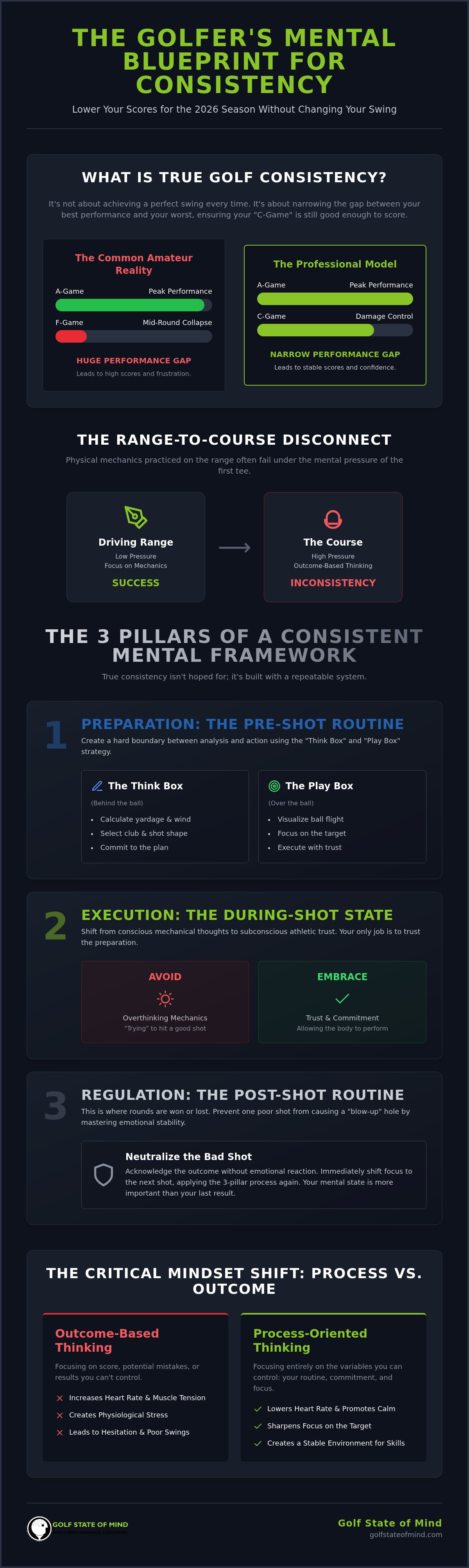
The Think Box
Before the shot, gather the information you need:
- Lie.
- Distance.
- Trouble.
- Conditions.
- Club and shot selection.
- Target.
Make the decision.
The Play Box
Then move from analysis toward execution.
See the shot.
Feel it.
Connect with your target.
Commit.
Play.
The Post-Shot Routine
After the shot, process the result.
Take any useful information.
Accept it.
Then move on.
The pre-shot and post-shot routines create boundaries around each individual shot.
8. Make Practice Transfer to the Course
A common reason golfers seek golf performance coaching is that their practice game doesn’t appear on the course.
Often, their practice doesn’t sufficiently resemble performance.
Technical Practice Has a Purpose
If you’re changing your swing, repetition is valuable.
Use drills.
Hit the same club.
Make rehearsals.
Work on the movement.
Performance Practice Has a Different Purpose
Once you’ve completed your technical work, make part of your practice more like golf.
- Use one ball.
- Change clubs.
- Change targets.
- Use your routine.
- Create different shots.
- Add scoring and consequence.
Now you’re practicing your ability to access the skill rather than simply repeat it.
Practice Pressure
Create challenges where individual shots matter.
Notice what happens when you’re close to completing the challenge.
Do you become cautious?
Technical?
Quick?
Indecisive?
That’s where the mental work begins.
Want to start developing these skills in your own game? My free 7 Key Mental Strategies ebook gives you practical mental-game strategies you can begin using in practice and on the course. Download the Free Ebook
9. Measure Your Mental Performance
Your physical scorecard tells you how many shots you took.
It doesn’t necessarily tell you how well you competed.
This is why I use a Mental Scorecard with players.
Choose Specific Commitments
You might measure:
- Commitment.
- Acceptance.
- Routine.
- Target focus.
- Response to mistakes.
- Staying present.
Choose one or two rather than trying to track everything.
Separate Process From Outcome
You can make an excellent decision, commit completely and hit a poor shot.
That doesn’t automatically mean the mental process failed.
You can also make a poor decision, swing tentatively and get a lucky bounce to five feet.
The result was good.
The execution wasn’t.
Learning to distinguish between the two helps you develop a more stable way of evaluating your golf.
What Happens During Golf Mental Performance Coaching?
Good coaching shouldn’t begin with the coach giving you a list of generic mental-game techniques.
It begins with understanding the player.
Understand the Golfer
I want to understand things such as:
- Where do you want to go with your golf?
- Why do you play?
- What happens when you compete?
- What situations create the most pressure?
- Where does your attention go?
- How do you respond to mistakes?
- What affects your confidence?
- How do you practice?
- What happens when you’re playing well?
- What happens when you’re playing badly?
Identify the Biggest Opportunities
Not every golfer needs the same thing.
One player may need to improve their response to mistakes.
Another may need a clearer pre-shot process.
Another becomes overly technical under pressure.
Another starts protecting their score whenever they’re playing well.
Another struggles with fear of judgment.
Build Skills Around the Individual
From there, coaching might involve:
- Process goals.
- Player identity.
- Pre-round preparation.
- Pre-shot routines.
- Post-shot routines.
- Breathing exercises.
- Visualization.
- Attention exercises.
- Performance practice.
- Mental Scorecards.
- Post-round review.
The objective is to develop a system that fits the golfer rather than forcing every golfer into exactly the same system.
Feel like your mental game is holding back the golf you know you’re capable of playing? I work with competitive juniors, college players, professionals and adult golfers to develop the mental skills they need to perform more consistently under pressure. Book a Free 15-Minute Consultation
Who Can Benefit From Golf Performance Coaching?
You don’t need to be a professional golfer to benefit from mental performance coaching.
Competitive Junior Golfers
Junior golfers face rankings, selection, recruiting, parental expectations and social comparison while they’re still developing their identity.
Good mental coaching can help them learn how to compete without allowing every score to become a judgment of who they are.
College Golfers
College players face qualifying, lineup selection, team expectations, academics and increased competition.
Having a reliable mental process can help create stability in an environment where results matter every week.
Professional Golfers
At higher levels, small differences in decision-making, commitment and response to pressure can have significant consequences.
Mental coaching can help players refine the processes they rely on in competition.
Adult and Club Golfers
The pressure may look different, but psychologically many of the challenges are remarkably similar.
A club golfer may worry about what everyone at the club thinks if they shoot 85.
They may become frustrated because their handicap has increased.
They may play beautifully in practice and struggle during the club championship.
The same fundamental skills apply.
How to Choose a Golf Mental Performance Coach
If you’re considering golf mental performance coaching, look beyond motivational language.
You want someone who can help you develop practical skills you can actually use.
Look for Golf-Specific Experience
Golf has particular demands.
There’s a great deal of time between actions.
You initiate the movement yourself.
Every shot creates a measurable result.
And you’re constantly moving between thinking, waiting and performing.
A coach who understands golf can apply mental performance principles to those specific situations.
Look for Individualization
Be cautious of anyone who tells every golfer to use exactly the same mental routine.
Your personality, experience, goals and performance challenges matter.
Look for Practical Application
Ask whether the coaching gives you things you can actually practice.
Understanding a concept is useful.
Being able to execute it on the 17th tee is what matters.
Look for a Process, Not Promises
No legitimate coach can guarantee lower scores, tournament wins or a particular improvement within 30 days.
Mental performance coaching should help you improve the behaviors and skills that contribute to performance.
The outcome will always contain uncertainty.
The Real Goal of Golf Performance Coaching
The goal isn’t to create a golfer who never gets nervous.
Or never becomes frustrated.
Or never has a negative thought.
And it isn’t to give you ten more things to think about before every swing.
The goal is to give you greater freedom to play.
Freedom to access the skills you’ve developed.
Freedom to make a committed swing without needing certainty about the result.
Freedom to experience pressure without believing something has gone wrong.
Freedom to make a mistake without allowing it to define the next shot.
Your technical skills don’t suddenly improve because you’ve strengthened your mental game.
They become easier to access and express.
That’s what effective golf mental performance coaching is ultimately trying to achieve.
Frequently Asked Questions
What does a golf performance coach do?
A golf performance coach helps golfers develop the mental skills and processes that influence performance, including confidence, focus, decision-making, routines, pressure management, emotional control, practice habits and response to mistakes. The goal is to help the golfer access their physical skills more consistently during play.
What is golf mental performance coaching?
Golf mental performance coaching applies mental performance principles specifically to golf. It can include player identity, process goals, attention control, confidence, pre-shot and post-shot routines, visualization, breathing, pressure training and performance practice.
How is golf performance coaching different from a golf lesson?
A traditional golf lesson generally focuses primarily on physical technique and ball striking. Mental performance coaching focuses on how you prepare, think, focus, decide, respond and compete. The two approaches are complementary, and many golfers benefit from working with both a technical coach and a mental performance coach.
Can golf mental coaching improve confidence?
Yes, confidence is a common area addressed in mental coaching. Rather than relying solely on positive thinking, golfers can build confidence from preparation, previous evidence, quality practice, improvement and seeing themselves respond effectively to difficult situations.
Can mental coaching help with first tee nerves?
Yes. Rather than trying to eliminate nerves completely, mental performance coaching can help golfers accept nervous sensations, regulate their level of arousal, narrow their attention and follow a familiar process. You can feel nervous and still hit a committed golf shot.
Can golf performance coaching help me take my range game to the course?
Yes. One important area is improving the way you practice. Performance practice uses one ball, changing clubs and targets, routines, scoring and consequence to recreate more of the demands golfers face on the course.
Can mental coaching cure the golf yips?
The yips are complex and shouldn’t automatically be treated as purely psychological. Mental performance work may help address factors such as fear, attention, conscious control and anxiety, but some golfers may also benefit from technical or medical assessment depending on the nature of the problem.
How long does golf mental performance coaching take to work?
There isn’t a universal timeline. Some changes in awareness or approach can happen quickly, while developing reliable habits and skills requires continued practice. Progress depends on the golfer, the specific challenge and how consistently the new behaviors are applied in practice and competition.
Is golf performance coaching only for elite golfers?
No. Competitive juniors, college golfers, professionals and adult amateurs can all benefit. The specific pressures may differ, but golfers at every level can struggle with confidence, overthinking, mistakes, pressure and transferring their skills from practice to the course.
What should I look for in a golf mental performance coach?
Look for someone who understands the specific demands of golf, takes time to understand you as an individual and provides practical skills rather than generic motivation. Be cautious of guarantees, rigid one-size-fits-all systems or claims that every performance problem is psychological.
What happens in a golf mental coaching session?
A session will typically explore your goals, current challenges, competition experiences, attention, confidence, reactions, routines and practice habits. From there, the coach can identify specific areas to develop and give you exercises or processes to practice between sessions.
Do I need a sports psychologist or a golf mental coach?
That depends on what you’re seeking. A golf mental performance coach generally focuses specifically on performance skills within golf. Sport psychology is a broader professional field with varying qualifications and scopes of practice. Mental-health or clinical concerns should be addressed by an appropriately qualified and licensed professional.
How do I know whether my problem is technical or mental?
Look at patterns across practice and play. If the same problem occurs consistently everywhere, technical factors may need attention. If your performance changes significantly when score, pressure or consequence is introduced, mental factors may be contributing. Often both are involved, which is why communication between technical and mental coaches can be valuable.
Get your FREE Mental Game Scorecard

Mastering Golf Consistency: The Mental Game Blueprint for 2026
What if the secret to your lowest round isn’t hidden in a new swing thought, but in the silence between your shots? You’ve likely experienced the…
Get your FREE Mental Game Scorecard