Best Golf Mental Coaching App: 2026 Performance Guide
Why does a swing that feels effortless on the practice range often crumble under the pressure of the final three holes? You’ve likely felt that…
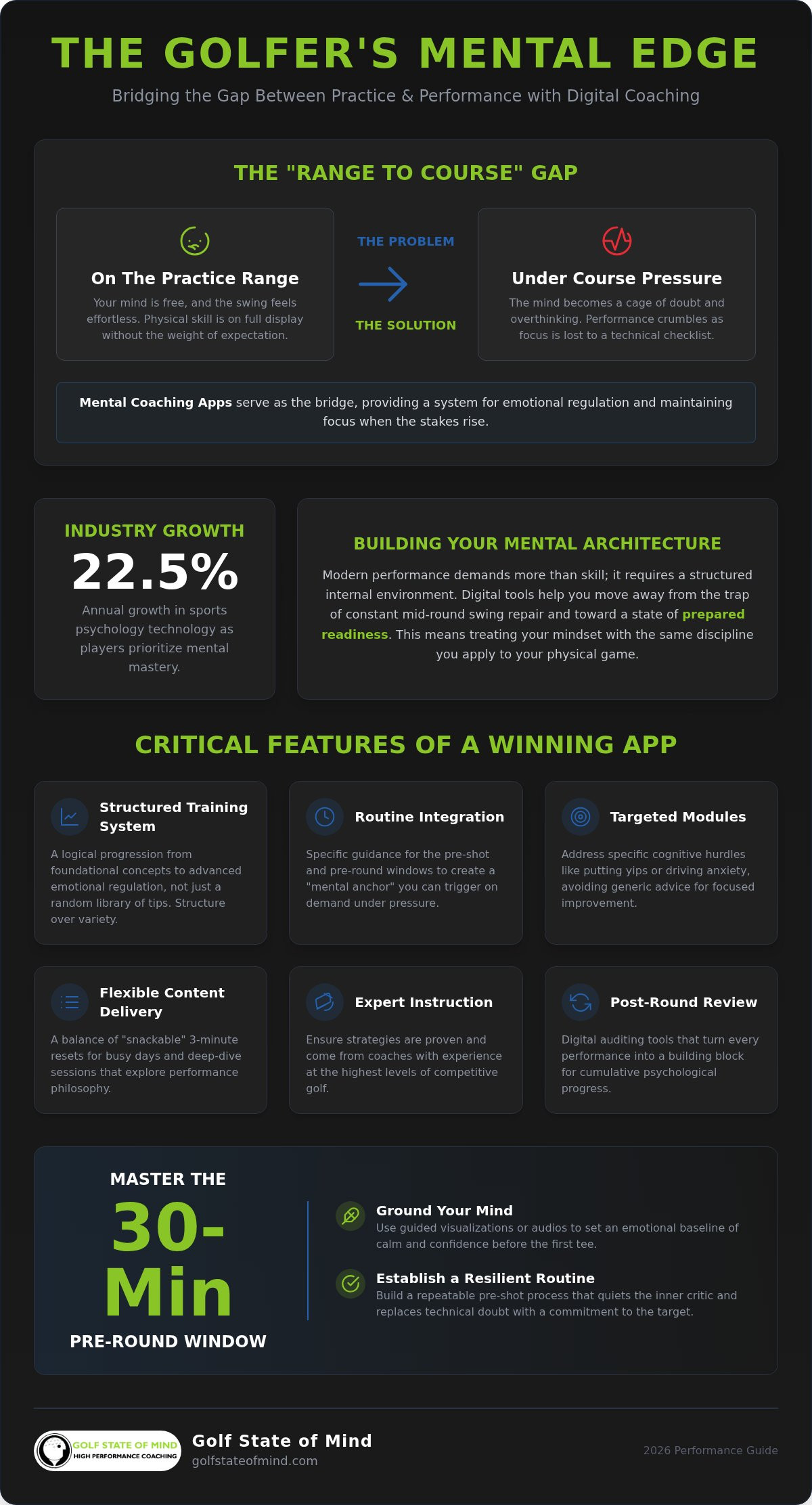
Get your FREE Mental Game Scorecard



Your golf swing doesn’t collapse under pressure; your attention does. Golfers often spend years pursuing a flawless swing on the practice tee, only to freeze when a card is in their pocket. Mental strategy governs execution; mechanics only execute what cognitive clarity allows. Developing a dependable golf mental strategy is the essential discipline that bridges the divide between practice capability and tournament scoring.
You already know the exhausting reality of standing over a clutch shot with multiple mechanical thoughts racing through your mind. It’s painfully familiar when a single bad bounce triggers an emotional spiral that derails three consecutive holes. By mastering a structured internal process, you’ll learn to silence overactive thoughts, neutralize first-tee tension, and commit decisively to every shot without altering your swing mechanics.
Below is your complete blueprint for on-course composure, designed to quiet your mind, build genuine resilience against mis-hits, and unlock the consistent scores your practice deserves.
Course management often gets confused with mental strategy. Calculating yardages or aiming for the fat part of the green is merely statistical arithmetic. Golf mental strategy is the intentional management of cognitive load, emotional arousal, and attentional focus before, during, and after every stroke. It is the internal operating system that dictates whether your physical capabilities translate into actual scores.
When you practice on an open driving range, you operate in a consequence-free environment. Without real jeopardy, your nervous system remains settled, and your body executes swings using automated motor programs stored in the cerebellum. On the course, however, real stakes emerge. Out-of-bounds stakes, water hazards, and scorecard scrutiny register in the brain as threats. This activates the amygdala, triggering a cascade of adrenaline and cortisol.
This biological reaction compromises fine motor control in two distinct ways:
Rapidly hitting twenty consecutive 7-irons to an open field creates an illusion of competence. Block practice allows your brain to correct errors through trial and error without resetting its internal baseline. In contrast, golf demands that you deliver a single, high-stakes swing every few minutes after walking hundreds of yards in quiet contemplation. When real consequences appear, golfers often abandon trust and attempt to guide the club manually, disrupting motor automaticity through conscious interference.
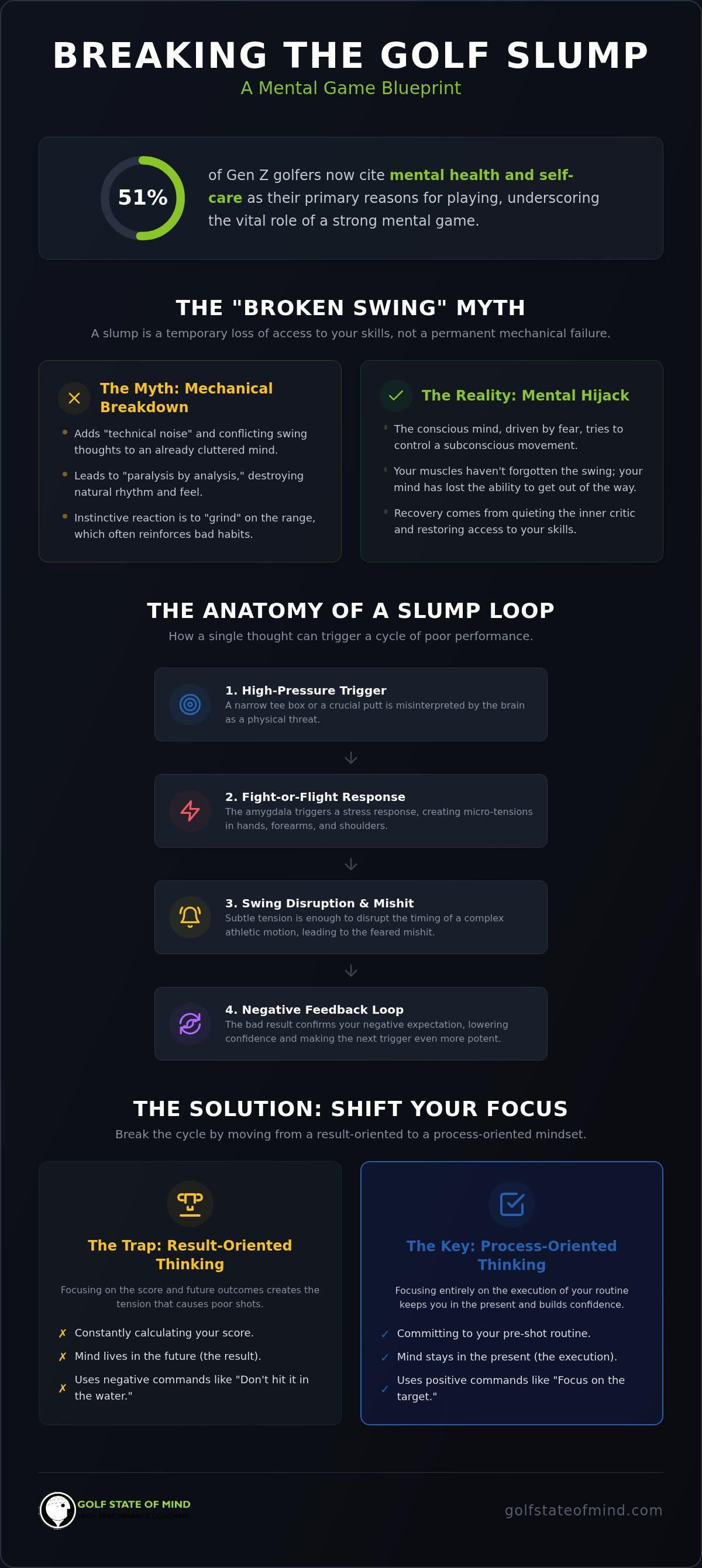
Standing over a shot while rehearsing wrist angles, hip rotation, and takeaway paths activates the prefrontal cortex. This conscious intervention disrupts fluid, sub-conscious movement patterns. The result is classic paralysis by analysis. The nervous system becomes overwhelmed by competing technical directives, creating hesitation at takeaway and deceleration through impact. Mechanics belong strictly on the practice tee; once you step onto the course, strategy and external target focus must take command.
A resilient mental game isn’t built on inspirational quotes or forced optimism. It requires a systematic framework that stabilizes your mind and body under pressure. An elite golf mental strategy relies on four interdependent pillars: Arousal Control, Attentional Focus, Cognitive Restructuring, and Process Orientation. Master these, and you gain command over your scoring potential.
Precision sports require an optimal autonomic state. Under the classic inverted-U hypothesis, too little arousal breeds lethargy, while excessive arousal degrades fine motor coordination. In-competition biometric tracking shows professional golfers experience heart rate surges of 20 to 40 beats per minute during high-stress situations. You can counteract this spike using physiological sighs: two quick inhales through the nose followed by an extended, slow exhale through the mouth. This somatic reset engages the parasympathetic nervous system, instantly releasing forearm tension and restoring baseline control.
Robert Nideffer’s attentional model reveals that peak performers continually adjust their cognitive lens. Between shots, your attention should be broad and external, absorbing scenery and chatting with playing partners to conserve mental energy. Attempting to maintain narrow, razor-sharp focus for four continuous hours produces severe cognitive fatigue on the back nine. Shift into narrow external focus only when stepping behind the ball to select a target, then release it immediately once the shot is complete.
Adversity on the course is guaranteed; emotional suffering is optional. Cognitive reframing replaces catastrophic self-talk with objective observation:
When you engineer these pillars into your weekly preparation through The Ultimate Mental Game Training System, composure ceases to be a mystery. It becomes an operational standard that protects your swing across all eighteen holes.
Most amateurs don’t play golf with an intentional framework; they simply react. When an approach shot catches a greenside bunker, the reactive golfer responds with anger, tries to fix their swing on the next tee, and desperately chases the dropped shot. A proactive golfer follows a pre-determined protocol. A structured golf mental strategy shifts your posture from emotional vulnerability to deliberate execution.
| Game Situation | Reactive Habit (Amateur) | Proactive Protocol (Elite) |
|---|---|---|
| Opening Tee Shot | Obsesses over mechanics; dreads an embarrassing miss. | Executes breathing resets; commits fully to a visual target. |
| Severe Mis-hit | Analyzes club path; carries frustration to the next lie. | Enforces a ten-second debrief; resets before walking forward. |
| Consecutive Bogeys | Chases pins aggressively to recoup lost strokes. | Accepts variance; plays strictly to conservative targets. |
| Clutch Putting | Steers the putter face; worries about the outcome. | Fixates on a single dimple; releases the stroke reflexively. |
Artificial positive thinking usually crumbles under competitive pressure. Forcing yourself to believe you will make every putt creates underlying tension because your subconscious recognizes the lie. According to PGA Tour ShotLink data, touring professionals make an 8-foot putt only about 50% of the time. Expecting perfection sets you up for emotional failure. Stoic acceptance, rather than forced optimism, frees your body to execute without fear.
Searching for technical swing fixes on the sixth hole guarantees cognitive overload. If your driver produces an unexpected fade on the front nine, don’t attempt to re-engineer your takeaway. Dance with the ball flight you brought to the course. Adjust your aim to accommodate your daily shot shape, apply wider dispersion buffers, and protect your scorecard until you reach the practice tee.
Losing your temper floods the bloodstream with catecholamines, degrading fine motor control for minutes afterward. To protect your upcoming shots, implement the 10-yard post-shot emotional boundary rule. You have ten paces from where you struck the ball to feel genuine frustration, analyze the commitment error, and process the outcome. Once you step past that invisible 10-yard line, the club goes into the bag, the shot is completely buried, and your mind returns to broad external awareness. By establishing clear boundaries, you prevent one poor swing from contaminating the entire round.
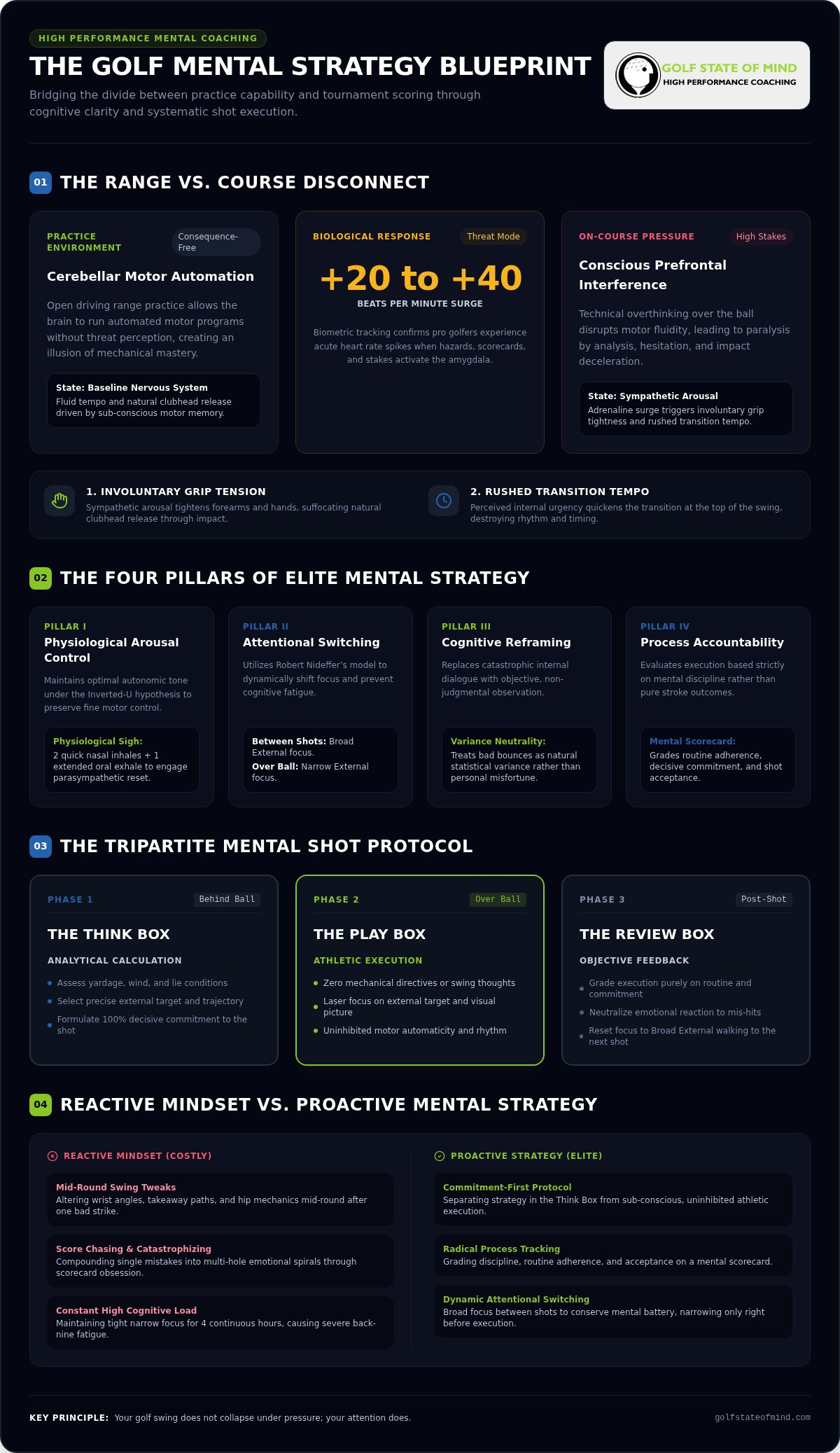
Most golfers assume a shot routine begins behind the ball and ends at impact. That assumption ruins consistency. A complete golf mental strategy divides every stroke into three non-negotiable mental zones: calculation, execution, and review. When you structure your mind into discrete compartments, you eliminate hesitation and emotional fallout.
Positioned two paces behind the ball, your conscious mind does all the heavy lifting. Assess lie conditions, yardage, wind direction, and hazards. Next, select a micro-target, such as a distant tree branch or a specific patch of green, rather than aiming vaguely at an entire fairway. Finally, make an unconditional decision on shot shape and trajectory. If a shadow of doubt remains about your club selection, do not step forward. Solve every question here.
Crossing an imaginary line into your stance marks the transition from analyst to athlete. The Play Box is strictly non-verbal. Rehearse feel, look at the target, and allow your subconscious motor system to take over. Research from the University of Exeter highlights the “Quiet Eye” advantage: elite golfers hold a steady visual fixation on a single point on the ball for 2.0 to 3.0 seconds before initiating the motion, saving an average of 1.9 putts per round under tournament pressure. In addition, European Tour data shows that maintaining brief, consistent timing over the ball yields a 90% increase in strokes gained on putts. If an intrusive mechanical thought interrupts your setup, follow this non-negotiable rule: step away immediately. Step back into the Think Box, reset your breathing, and begin again.
The stroke is incomplete until you conduct a neutral debrief in the Memory Box:
To master these three distinct phases and build unshakeable discipline under pressure, explore The Ultimate Mental Game Training System and integrate this protocol into every round.
Relying on scattered tips collected from magazines or casual range chatter won’t hold up under medal play. Psychological resilience requires deliberate engineering. To make your golf mental strategy truly dependable, you must transition from passive intellectual agreement to daily, structured protocols that you train with the same discipline you dedicate to your short game.
Traditional scorecards measure only gross outcomes, which are frequently distorted by unexpected gusts, bad bounces, or lip-outs. A process scorecard shifts your focus to controllable variables by auditing your internal discipline on every shot. Grade yourself using three simple criteria across each hole:
Tracking these key performance indicators reveals a consistent pattern: high process scores invariably lead to lower gross scores over time. More importantly, grading your process protects you from panic during temporary slumps, keeping your emotional baseline steady when putts refuse to drop.
Composure is a trainable capacity built away from competition. Schedule dedicated stress-inoculation practice rounds, such as playing two balls and always taking the worse lie, to condition your autonomic nervous system to stay calm under duress. Supplement these on-course drills with daily mental conditioning, using auditory reinforcement and visualization exercises to groove reflexive confidence under tournament heat.
To turn these principles into a permanent, tour-tested blueprint, implement The Ultimate Mental Game Training System. When your psychological preparation becomes an engineered habit rather than accidental optimism, consistent scoring naturally follows.
Lowering your handicap doesn’t require rebuilding your swing from scratch. It demands an engineered, repeatable golf mental strategy. By regulating physiological arousal before each shot, stepping across the commitment line with complete clarity, and conducting neutral post-shot audits, you protect your natural athleticism under pressure. When you measure process execution rather than obsessing over the scorecard, emotional spirals vanish and consistent scoring follows.
For over 15 years, mental performance coach David MacKenzie has guided European Tour players and elite amateur champions in bridging the gap between practice-range capability and tournament execution. You don’t have to leave your composure to chance. Master your mental game with The Ultimate Mental Game Training System to build a measurable, tour-tested framework for every round. Step onto the first tee with calm confidence, commit fully to every decision, and let your prepared mind clear the path to lower scores.
The most effective golf mental strategy for beginners is radical target commitment coupled with process simplicity. Beginners often clutter their setup with half-remembered mechanical swing tips. Instead, choose a wide, safe landing area and select a clear intermediate focal point a few inches ahead of the ball. Commit to finishing in balance on your lead leg. By prioritizing where the ball should travel rather than how your body moves, you allow natural athletic instinct to develop freely.
Yes. Most amateur strokes are lost to emotional spirals, unforced tactical errors, and tension rather than deficient swing mechanics. An intentional mental approach prevents compounding mistakes by stopping emotional chasing after a poor shot. It relaxes grip pressure, preserves natural tempo under tournament nerves, and sharpens short-game decision-making. Better course management and complete commitment over putts routinely shave three to five strokes per round without altering a single element of your physical swing.
You stop overthinking by establishing a clear boundary between planning and swinging. Resolve every technical and strategic question two steps behind the ball. Once you enter your address stance, shift your focus to an external anchor, such as the dimple on the back of the ball or the precise sound of crisp contact. If a mechanical thought slips into your head, back off immediately. Reset your breathing, step away, and restart your routine from the beginning.
When your mental composure slips, perform an immediate somatic reset between holes. Take two sharp inhales through the nose followed by a slow, elongated exhale through the mouth to drop your heart rate. Let go of past holes and abandon all score calculations. Strip your expectations down to a single goal: executing your pre-shot routine with complete commitment on the next swing. Treating the next shot as an isolated event prevents a temporary slip from ruining the entire round.
A pre-shot routine is the operational delivery system of your mental game. While your broad strategy dictates course management and emotional regulation across eighteen holes, the pre-shot routine governs individual execution. It systematically transitions your brain from conscious calculation behind the ball into automatic athletic release over the ball. Without a repeatable routine, your mental game remains theoretical; the routine transforms internal discipline into consistent physical execution on every single stroke.
Forced positive thinking rarely works as a dependable golf mental strategy under pressure because your subconscious detects the underlying doubt. Telling yourself you will make every putt generates subtle anxiety when conditions are difficult. Stoic acceptance is far more reliable. Accept that golf balls naturally disperse and bad bounces happen. Replace artificial cheerleading with clear, objective directives: pick your line, regulate your breathing, and execute your stroke with total commitment regardless of the circumstances.
Measure mental growth using a process scorecard that rates execution discipline rather than gross score. After every hole, record whether you maintained complete commitment over the ball, stayed patient between shots, and executed a neutral post-shot review. When your percentage of committed swings rises from 60% to 90% across eighteen holes, you have made measurable psychological progress. Improved gross scores will inevitably follow this consistency in mental execution.
Why does a swing that feels effortless on the practice range often crumble under the pressure of the final three holes? You’ve likely felt that…
The more you attempt to consciously control your swing mechanics during a round, the more likely you are to remain trapped in a performance plateau….
Research shows that an active dynamic warm-up can decrease your shot error rate by over 47 percent, yet most golfers spend their morning reinforcing…